Review of The Field Guide to Frontline Care: Practical Tools for Workers in Homelessness, Substance Use, and Harm Reduction
You need this book yesterday. I need this book in 2011. We collectively need this book in the 19th century.


The Field Guide to Frontline Care: Practical Tools for Workers in Homelessness, Substance Use, and Harm Reduction by Marcus Greatheart, Ethica Press 2026
Of all the excellent books I've reviewed here so far, curers of addiction, this one is the most urgent for practice. You need this book yesterday. I need this book in 2011. We collectively need this book in the 19th century.
Author Marcus Greatheart is the first physician I've heard of (MD) who also has a social work degree. He works on Vancouver Island, Canada, primarily with patients who are unhoused and have substance use and mental health difficulties. I've complained about the low quality, or outright absence, of social media pertaining to addiction care, but Dr. Greatheart is an exception. I first found him on Instagram @docmarcusg, where he shares and solicits insights from working in this field. Some perspectives can only come from practicing direct service. We are the last people asked to advise on policy, but the first to know its impact– and Greatheart gets it.

In the introductory section, "How To Use This Book," he makes clear it is not intended to be read front to back. A true field guide, it's meant to be accessed on the spot, in pieces, according to the reader's immediate need. In total, it's just 137 pages of simple, concise paragraphs and bullet-style lists.
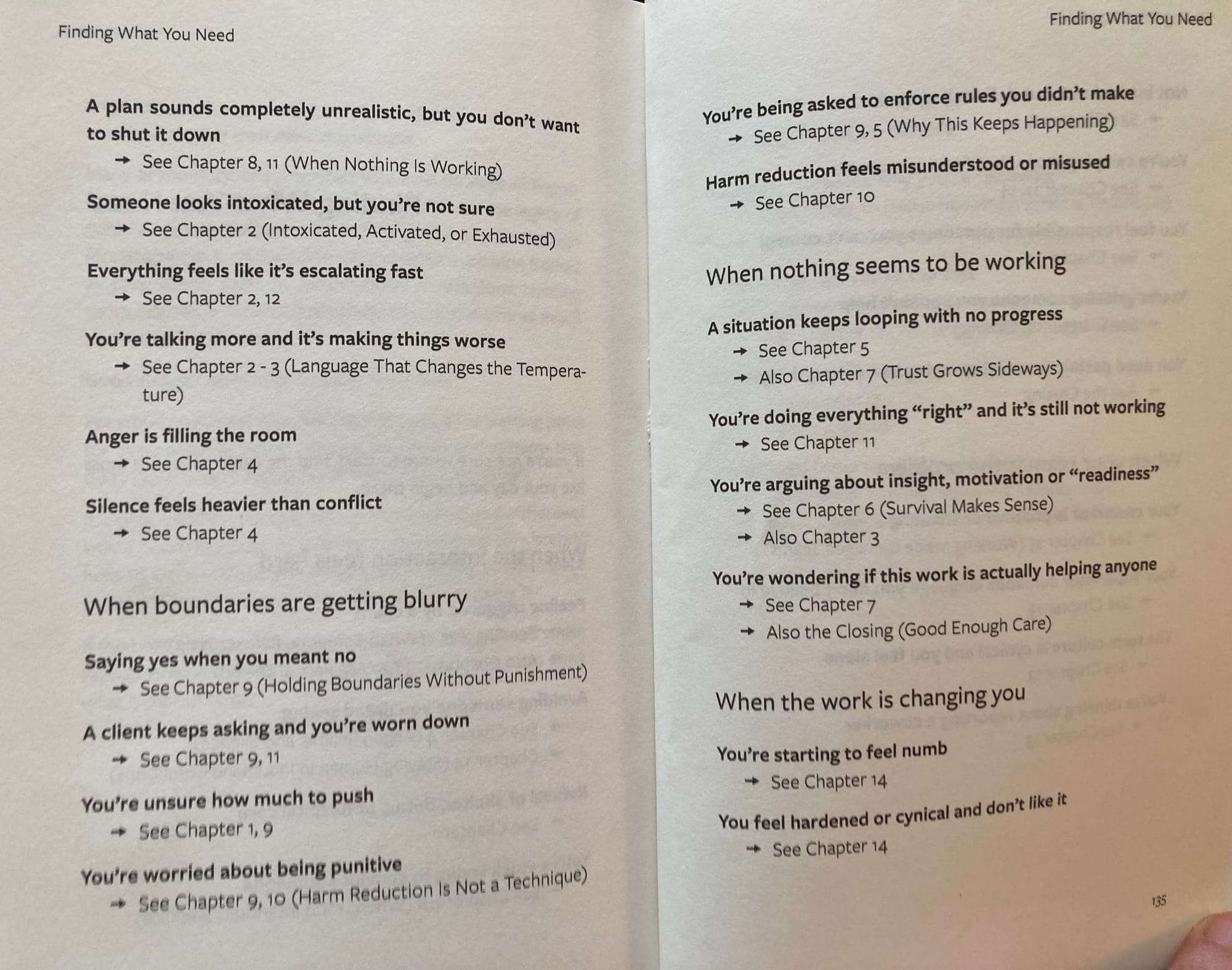
I saw that Chapter 11 is called "When Nothing Is Working" and, taking the instructions to heart, went straight there first. I definitely need to know what to do when nothing is working! Even more practical is the index at the back, "Finding What You Need." Here's a sample to show how straightforward and usable it is, well-adapted to the kind of chaotic setting where this work usually happens:
From my limited experience with how-to clinical books, this one is exceptionally grounded in reality. Greatheart addresses how much anger, hostility and despair we encounter day to day. He advises on how to work with our own sense of helplessness amid systems that deny our patients' needs. He recognizes the value of boundaries, consistency, and basic safety– including our own. He discusses how to moderate expectations for ourselves without turning our people into units or data points.
I can only imagine what might have happened had book shown up at one of my old agency jobs. So much conflict and turmoil– within myself, between me and my peers, and between staff and management– came down to these kinds of challenges. But system-level reflection was not allowed, let alone encouraged. If we had not had to do it ourselves from whole cloth, developing all principles and vocabulary during bathroom breaks, might we at least have come closer to baseline humanity in our frontline roles? Might our organizations have come closer to actual harm reduction– not cynical shortcuts that could be called "harm reduction"– in patient outcomes?
Although The Field Guide to Frontline Care is designed for readers (users) in direct service, academics, policymakers and advocates might learn even more from it. Scholars of social services and the nonprofit-industrial complex have shown how formalized community work is really about managing abandoned populations. For those who don't know first-hand, this book is an education on what it feels like to be the face of austerity and the voice of coercion. Appropriately, there's a chapter on "Staying Human" and some gentle guidance on when one might need to quit.
NIW
I'll go a bit deeper on the first section I consulted: "When Nothing Is Working" (NIW). First of all, even addressing NIW shows a rare respect for the reader, and also rare humility from the author. I wish all clinical trainings and guidelines had a NIW section, because too many authorities, in therapy at least, focus all their content on the brilliant breakthrough and the pat resolution– as if their style of intervention always works.
I learn much more when educators and writers dive into NIW. I recently attended a training through the Austen Riggs Center about people who never recover from trauma. This was the first time I had ever come across clinical reflections on trauma non-recovery. I have always had patients who describe themselves this way– as permanently unable to move beyond their trauma– but never once been in a professional discussion about it. NIW guidance also seems essential for substance use treatment because the people who end up in treatment are the minority who were unable to resolve their drinking or drug problems for themselves. In other words, our patients arrive having already found NIW in individual, non-clinical processes.
"Survival Logic" and Where This Guide Can't Go
Throughout the guide, Greatheart emphasizes that people make choices based on immediate needs. Decisions to refuse services, return to unsafe relationships, or continue using substances need to be understood as "survival logic," which may not look like rational thinking. Likewise the potential costs of change, including a loss of familiarity or control, are much greater to someone operating on survival logic than might be intuitive to professionals working with them. Greatheart implores us to "stop expecting people to behave as if they have stability when they don't." When we ignore the brutal conditions of patients' lives and look only at their choices, we risk a mindset of contempt.
I fully agree with all of this. But there's no word on people who do have stability– and they've always been part of addiction work. These are folks with stable income, housing, and relationships, whose material needs are fully met with no reason to fear that could change. In my first jobs in substance use, in fact, my patients had exceptional privilege, being students at elite private colleges whose expenses were all covered, and then some, by their parents. Next I worked in community clinics, where survival logic was prevalent but still not universal. Now, in solo practice, with all voluntary clients, few people I'm working with are currently in survival logic. Yet with all these populations, I've hit NIW regularly. It's relevant enough to my substance use practice today that again, my first need from this book was the NIW chapter. But survival is not remotely in question for the cases I'm thinking of, so it really does not apply.
 Rosalie Genova

Is a clinician's contempt justified when someone acts self-destructively without the excuse of unmet needs? Obviously not, and I'm sure Greatheart doesn't mean to suggest otherwise. But I point this out because the guide has limited applicability outside of material survival logic. It sidesteps the question of what addiction is other than coping with deprivation. Unfortunately, an international backlash against harm reduction is underway at this time, including a rejection of the idea that addiction is always about survival. I believe we need space to acknowledge it is not, without setting anyone outside the bounds of empathy.
Mainers, watch the newsstands! I have another cover story for the Bollard November issue– this time on Mayor Dion's response to addiction and homelessness in Portland (reflecting the backlash against harm reduction mentioned above). Readers from away, I'll share the story here once it's online.