Review of Trial By Treatment: Punishing Illness in an Age of Criminal Legal Reform


If you're looking for a good celebration today, here's "250 Years of Resistance," recorded last night at the National Public Housing Museum. Bring a notebook and a cup of coffee. On to today's post...
Trial By Treatment: Punishing Illness in an Age of Criminal Legal Reform by Mary Ellen Stitt, University of Chicago Press 2025
It sounds so much better than locking people up. "Pretrial diversion" is an approach to prosecution, ubiquitous in US criminal courts today, in which people arrested on drug charges are referred to treatment in lieu of jail. As long as they complete their assigned program, their charges are dropped, and they have no further obligation to the court nor any criminal record from the arrest.
Trial By Treatment is a multi-method examination of diversion– and demonstrates how rarely it actually plays out this way. Author Mary Ellen Stitt, a scholar of sociology and criminal justice, used surveys, interviews, and immersive experience as a participant observer to study the diversion process. Her research covers every stage and contingency: from prosecutors' decisions to bring charges and offer diversion, through the process of mandated treatment, to defendants' exits from diversion– either by completing and getting "off paper" or, more often, ending up in jail.

Many, if not most defendants do not meet program requirements to attend treatment and court dates, and test negative for drugs. Such "failures" are more common for defendants who are poor, Black, and have significant substance use or mental health issues. However, judges and prosecutors consider diversion a lucky break for defendants, and its requirements minimal. People who "fail" diversion, then, look like they "don't care" or lack self-control: the type likely to reoffend. These individuals frequently face more serious charges and longer sentences than they would have without the diversion protocol.
Key Findings
As the title suggests, Stitt shows that through diversion, adjudication has effectively moved from the court to the treatment milieu– at the expense of people's rights and of transparency. She points out that, for all its problems, the court process is based on findings of fact and formal negotiation between parties. Arguments and decisions in court are recorded, producing data that can be evaluated by the public. Treatment, by contrast, is a "black box"– this phrase appears in basically every book about addiction treatment, and I don't disagree– where decisions may be based on vague impressions, with little or no explanation. Treatment records are strictly confidential, and we have no data on diversion outcomes because they are determined by treatment providers, not in court. Stitt studied both "in-house" treatment programs, where therapists work directly for the diversion entity, and "external" facilities where diverted defendants were referred. (I have worked in the latter scenario.) She found that both treatment systems defer to the criminal legal system over clinical principles because both rely on the legal system for funding, whether directly or indirectly.
Drug court proponents tout the low recidivism rates of people who complete diversion as evidence that it "works." However, only about half of defendants actually complete, similar to completion rates in community addiction treatment. It's certainly convenient to set aside ~50% of total outcomes as irrelevant, rather than investigating what such high numbers of dropouts and "failures" might say about the services on offer. Furthermore, defendants who do complete diversion disproportionately represent the same demographic groups (white, middle-class) who are least likely to be rearrested anyway. In other words, we have no evidence that the diversion process makes a difference even for those who succeed on its own terms.
Highlights
These arguments were the most compelling– even cathartic– for me.
Diversion can be "anything to anyone." Stitt shows that diversion is such a popular policy because it can shape-shift to suit any taste– especially in a vacuum of information as to how it actually works. For progressives, it looks like a more humane and rational alternative to incarceration for people who "need help." For conservatives, it's a money-saver that still promises jail for those likely to be rearrested. With diversion, treatment programs get to claim credibility for rehabilitating people and keeping the streets safe. Police departments and district attorneys get to increase their volumes of arrests and charges under cover of connecting people to services. The only involved group not benefiting from the diversion model, as Stitt sees, is defendants themselves.
Diversion makes treatment a form of punishment. Invariably, defendants expressed that they were just trying to get through their time in mandated treatment– like a sentence behind bars. They shared as little as possible with their counselors for fear that any sign of personal difficulty could extend their time. Every defendant Stitt spoke to said they saw their treatment as punishment, and some additionally saw it as a means of financial extraction. Of course, this "client" experience is not conducive to anything we could call therapy. The counselors Stitt interviewed sound utterly incoherent trying to rationalize this setup (in interviews with her) and do their jobs (in sessions she observes)– and that was me until 2022.
Diversion leads to "net-widening" in drug enforcement. Stitt is not first to point this out, but Trial By Treatment illustrates it in more detail and more concretely. For minor drug offenses like possession, police are more likely to make arrests, and DAs are more likely to bring charges (by around 42%, she finds), when they know diversion will be an option. Authorities even see arrests and charges as a way to connect people with services, as if doing them a favor.
The net-widening for addiction treatment referrals showed most starkly to me in what Stitt did not write. At one point she refers to a group of people in mandated treatment "with a substance use disorder," and I was like, wait– isn't that everyone? Who else would be there? Why would even one person be in treatment for a condition they don't have? I thought I had seen it all, but I have never seen this: apparently under diversion rules, some people end up in substance use treatment without a diagnosed substance use disorder. Of course, we can't know exactly how many! No wonder addiction providers are often suspected as quacks and grifters.
Diversion programs all match the emperor's new clothes. This book was the first piece of research to confirm something I observed working in treatment agencies: that they all mimic each other as an end in itself. Every discussion about protocol, in my clinic staff days, came down to what other organizations were doing. Not what worked, or what was supported by research– only, literally, what other programs were doing. Why? Because other programs were doing it. Zooming out on this phenomenon, it is even sillier given how little substantive rationale there is for mandated treatment, and how little data is available on results from diversion for the full population of diverted defendants– not just the sub-set who complete.
One Objection
The only aspect of Trial By Treatment that didn't work for me is its reliance on the concept of "illness." Stitt fully buys in to the "brain disease" model of "substance use disorder" (addiction is just a colloquial term for SUD, we're told). She consistently refers to people using drugs as "ill" or "sick," and does not acknowledge any other conceptions of addiction or debates around these diseased characterizations– which have been challenged by drug users themselves. And here's how she describes ongoing use during treatment: "Those dealing with chronic pain, symptoms of trauma, or mental illness are often unable to avoid substance use and pass drug tests."
Respectability alert! Pity warning!🚨 We're given three acceptable reasons someone might be "unable to avoid" using drugs when it might lead to jail. No other motives are entertained– like that People Enjoy Using Drugs.
 Rosalie Genova
In a book otherwise masterful in its critique of received wisdom, this oversight stood out as an exception. Stitt's justice-based argument could easily hold up without the disease model and associated baggage. In ignoring the role of personal agency in substance use, she may turn off people with lived experience who would otherwise be fans.
Overall, Trial By Treatment is pointed, rigorous, and timely. Pretrial diversion has become such a consensus policy that anyone who cares about criminal justice or addiction treatment should read it.
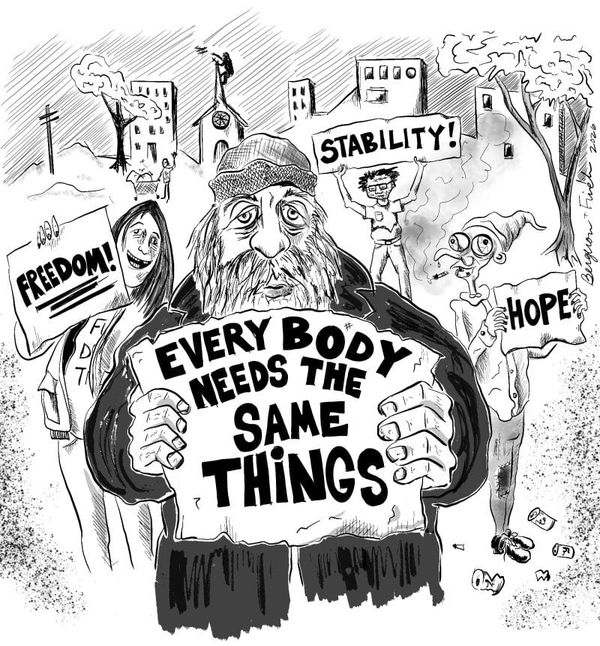
Maine curers of addiction: Check out the July issue of The Bollard! I wrote the cover story, titled "Everybody Needs The Same Things." It's analog only for now, but I will share it here next month when it's online.